Spec of Record (SoR)
Spec of Record is a development philosophy and toolchain for AI-built software, where one or many agents build from a single spec, aimed at mid-sized to large projects. It turns the spec into a centralized design document that always stays in sync with the code, so team members with different areas of expertise can understand, review and change the software together. You write what your software should do in plain language, an AI agent turns it into code, and each piece of code stays linked to the statements of the spec and to its test results.
Run in a terminal
claude plugin marketplace add sebastianrath/specofrecord && claude plugin install specofrecord@specofrecordOther ways
Already inside Claude Code? Paste one line at a time
/plugin marketplace add sebastianrath/specofrecord/plugin install specofrecord@specofrecordNo claude command? Install Claude Code first (macOS and Linux, other systems)
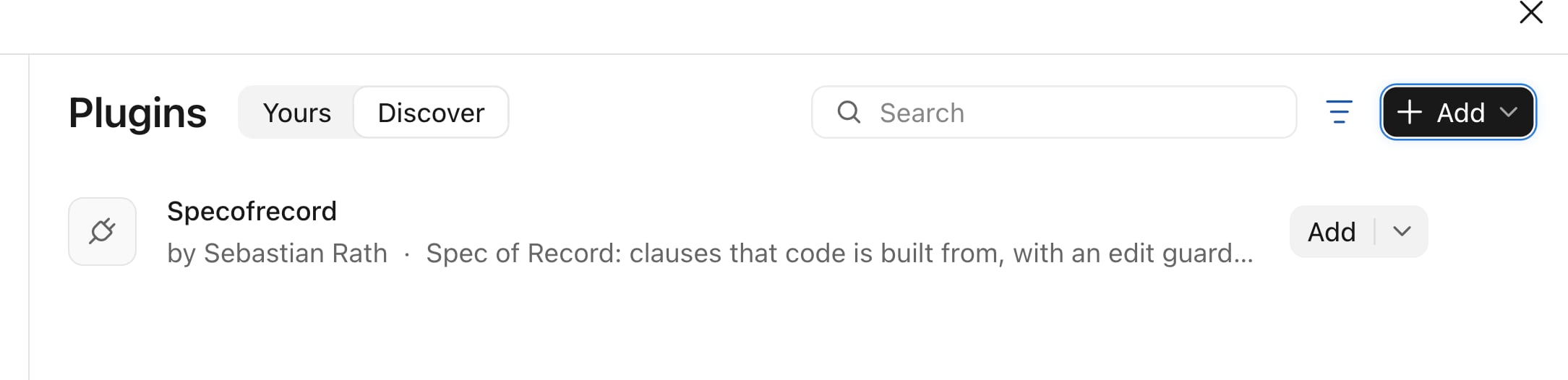
curl -fsSL https://claude.ai/install.sh | bash- Open Customize → Plugins → Add → Add marketplace → Add from a repository.
- Paste this repository and sync it:
sebastianrath/specofrecord- Open Discover, pick Spec of Record and press Add.
Starting from scratch? In an empty folder, tell Claude Code what you want to build. For example:
I want to build a game engine. Write the first specs following Spec of Record for a game engine that...Already have code? Name the one thing you are about to change. Only that part goes under a spec, and the rest stays as it is. For example:
I am about to change the checkout. Put just that under Spec of Record first, then make my change.Why use SoR?
The reason a code line exists usually lives in a verbose commit message, a Jira ticket or a Slack message, not in the code itself. AI can write code quickly and loves to rewrite larger parts of the source code because it feels like it. AI agents mostly find context with a keyword search like grep, so when someone makes a change, they either miss things they should address or change too much.
Over time, the team loses track of how their software actually works. In a review, you face hundreds of new lines that nobody can meaningfully trace, and you send them back to the AI with "fix this" or wave them through with LGTM (sry that's me, I do that). The AI needs help too. Round after round of fixes, it keeps changing code until it has moved so far away from what it is meant to address that no one understands it anymore. It is a quality and liability risk.
Here is what Spec of Record offers, for people and AI:
- The
sor/folder is your newsrc/folder, hierarchically structured like source folders used to be, only more compact. It contains up-to-date spec files, each covering one responsibility. There is no stack of old versions, so everyone knows what the software does now and how. - Product, engineering, QA and UX each work in their own field of expertise while sharing a common design document. You decide what the software does and stay its author.
- A change to one clause in a spec file changes only the necessary code and reduces drift. It gives AI tremendous guard rails for attention and context.
- Several agents can work in parallel, because each claims its spec clauses before touching anything, and a clause someone else holds is refused.
- Every line of code names its origin in the spec and every finished build keeps its test results. "Why is this here?" and "Was it tested?" become easy lookups.
Where it fits in spec-driven development
Spec-driven development means writing down what the software should do and letting an AI write the code. The term is overloaded, so it helps to be clear about its meaning. The difference is what happens to the spec after the code exists. Birgitta Böckeler of Unblocked describes three levels:1
| Level | What happens to the spec |
|---|---|
| Spec-first | Written to get one task done, then left behind. |
| Spec-anchored | Kept after the task and updated as the feature changes. |
| Spec-as-source | The only thing people edit. Nobody touches the code. |
| Spec-of-record | This proposal. |
Where spec-driven development goes wrong
A design document is only useful when it's up to date. Spec drift is what happens when the spec says one thing, the code does another, and nobody can tell which is right. It creeps in one small change at a time.
Most spec-driven development is spec-first, which makes it a good place to look at the potential traps. The spec is written for one task and then put away. The code keeps changing, and the spec stays as it was.
Take a game. Its spec says the player needs 3 keys to open the exit, and the designer asks for 5. The AI changes the code, and nobody updates the spec, because nobody asked or the AI forgot. Now the spec says 3, the game asks for 5, and no one knows what should be true.
Spec-first has a second trap, and it catches the teams that avoid the first one. To keep the spec up to date, they write a follow-up spec for every change, so you end up with SPEC.md, then SPEC-2026-01-08.md, then another one. To learn what the software does today, you read them all in the right order. They become incredibly verbose and eventually no one reads them anymore.
In spec-as-source, people edit only the spec and the code is generated from it. You can't fix the code by hand, so every fix goes through the spec, and because an AI does not generate the same code twice,1 the result can come back different each time.
Spec of Record extends spec-as-source and allows hand edits on purpose. You can change either side, the spec or the code, and the other one is updated to match. Finished code is kept, so a change to a clause rewrites only that clause's code, and the clause's tests check the result. The bundled tools enforce this: they check that spec and code agree, block AI edits that skip the clause, and flag any mismatch until it is fixed.
How it works
The spec is split into parts, one Markdown file for each area of the software, such as a game's logic or its multiplayer networking. Each part says why it exists and lists its rules, its approach, what it needs from other parts, what it gives to them, and its tests.
The unit is a clause, which is one rule, one number or one table row. Every clause comes with a marker, a short comment above its code that names the clause. Below is a clause and the code built from it, so you can see each side point at the other.
...
turn – Each key press moves the player, picks up keys and moves the monsters.
...
// @clause run/turn
export function takeTurn(game, dx, dy) {
  move(game.player, dx, dy);
  keepInRoom(game.player);
  pickUpKeys(game.player, game.keys);
  ...
}
// @clause end
// @clause run/turn
export function moveMonsters(game) {
  ...
}
// @clause end
With that association in place, a change stays local. Say you want the player to move only on every second key press. You change that one sentence, and the AI updates just the code blocks marked with that clause.
If you know how a compiler works, you can apply that concept to Spec of Record, with the AI playing the compiler.
| Legacy development | Spec of Record |
|---|---|
| You write source code | You write the spec |
| A compiler turns it into a program | The AI turns it into code |
| Only changed files are rebuilt | Only the affected code is rebuilt |
| Tests check the program | Each clause can have its own test |
A real compiler gives the same output every time, so it can throw that output away and start over. An AI cannot, so Spec of Record keeps finished code.
Several agents can work on one project at once. A sub-agent first claims a spec clause and its code blocks. It changes the clause, then the code, locks the result and releases the claim. A clause that someone else holds is refused.
One key press moves the player 20 px, and the player cannot leave the 500 px room.
// @clause player/movement
const STEP = 20;
export function move(player, dx, dy) {
  ...
}
// @clause end
A new player has 3 lives.
// @clause player/lives
const START_LIVES = 3;
export function withLives(player) {
  ...
}
// @clause end
// @clause player/movement
const ROOM = 500;
export function keepInRoom(player) {
  ...
}
// @clause end
Every turn a monster steps 20 px toward the player.
// @clause monsters/chase player/movement
const MONSTER_STEP = 20;
export function chase(monster, player) {
  ...
}
// @clause end




An agent claims a clause with sor claim before it touches anything.
Tools can follow the marker links too. An editor extension jumps from a spec to its code and back, and the sor command line interface (CLI) gives an AI or a script the same answer as text or JSON. A clause can also reach further back, to a source outside the code such as a Figma design.
In your editor
The VS Code extension shows these links on a sample project. You do not need it to use Spec of Record, but it is a handy way to see them.
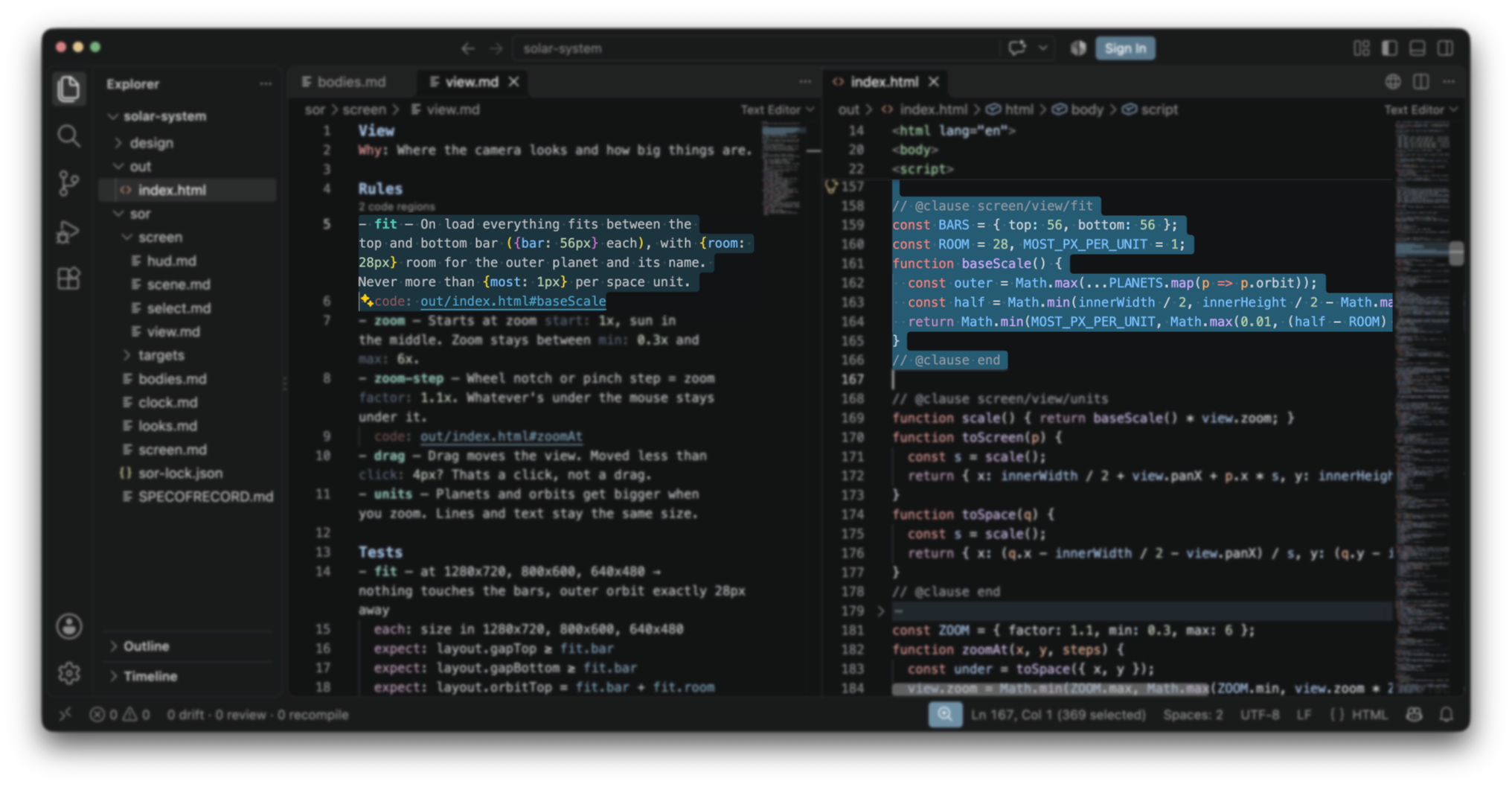
- Open a spec and each clause shows the code regions built from it, with links to them.
- Open the code and each region shows its clause and whether the two still agree.
What you get
Beyond the editor extension, Spec of Record comes with a CLI, sor, and an edit guard for your AI agent. Here is what they do:
- The change list shows what changed since the last build and which code needs rebuilding.
- The edit guard stops the AI from changing code before its clause.
- The test runner runs each clause's tests and tells you how many clauses pass.
- The build record remembers, for every clause, whether its tests passed, so you can look up later what was tested.
- For AI, scripts and CI, the CLI answers directly. For example,
sor markerssays which clause a line came from, or which code a clause produced. Other commands show a clause with its code and map the spec.
The build record
If you manage a team or answer to auditors, this is the section for you.
The build record is a checkpoint. Each time a piece of work is finished and the specs, the code and the tests agree, the tool saves one, together with the test results. Later it compares the project with that checkpoint to see what changed, and you can look up what was tested. It is a plain file in your repository, so version control keeps every earlier checkpoint.
| Question | Answer |
|---|---|
| Why does this line of code exist? | Its marker names the clause it serves. |
| What code does this clause make? | The clause points to all of it. |
| What did this change affect? | The change list shows it. |
| Who changed it, and when? | Version control shows it. Code changed without its clause is flagged, with author and date if you use git. |
| Was it tested? | The build record stores the results, and version control keeps the history. |
| Does every result come from an automated test? | Yes, except for checks a person signed off by hand. An AI cannot sign off. |
That helps with reviews, handovers and compliance checks, anywhere a change has to be explained later.
Common questions
Is this more documentation to maintain?
No, it replaces the documents you would otherwise write. The spec is what you edit. A change edits a clause, and a new feature adds clauses, or a new part, to the same set of files. There is no second copy buried in Confluence or Slack.
Do I have to convert my existing project?
No. Start with the one thing you are about to change, as in the install steps at the top. The rest of the code stays as it is.
Where do the specs live?
In a sor/ folder next to your code, as plain Markdown files you commit with it. There is no service to run and no account to create.
Will building my entire project with SoR create a dependency?
No, there is zero dependency. The code is plain source with marker comments in it, so you can delete the specs and carry on from the source, or switch to another engineering approach.
Which languages and tools work?
It is agnostic to language, framework and editor. Today the workflow ships as a Claude Code plugin, and other agents and editors are open for contributions.
What if I change the code myself?
Go ahead. Your change stays. The tool flags it as code changed without its clause (with author and date if you use git), and the AI rewrites the clause to match what you did.
What if the AI builds something wrong?
The clause's tests fail, and the code is fixed until they pass. Clauses with no passing test are listed, so a gap is visible instead of hidden.
Can several people or agents work at once?
Yes. Agents claim clauses, as shown above, and people on different machines coordinate through version control, the way they do now.
Related projects
Spec-driven tooling is a crowded field. The projects below cover different parts of the workflow. Some have gone quiet or are paused, and some are tied to one editor, agent or service. Spec of Record borrows ideas from several of them and adds its own.
| Project | What it does |
|---|---|
| Spec KitSpec-first or anchored | Commands and templates that take a feature from spec to plan, tasks and code. From GitHub. |
| OpenSpecSpec-anchored | A proposal for each change. When the change is done, it is merged into the specs. |
| KiroSpec-anchored | An editor with requirements, design and task files for each feature, plus hooks that run on events. |
| BMAD-METHODSpec-first or anchored | A method with agent roles for product, architecture, UX, development and testing. |
| PurlinSpec-anchored | Rules and proofs in specs. Ties tests to rules and marks results out of date when the spec, code or tests change. A Claude Code plugin. |
| CodeSpeakSpec-as-source | Specs that a tool turns into code. In alpha. |
| TesslSpec-as-source | A registry of skills and context for agents. Its spec-as-source Framework is paused. Its spec-driven-development tile is open source. |
| nimaSpec-anchored | A hosted service that turns signals from tools like Slack, Linear and Sentry into specs, and checks pull requests against them. In private beta. |
| DriftSpec-anchored | Binds Markdown docs to code files or symbols. Flags a doc as stale when its code changes. |
| CoherenceSpec-anchored | Checks that code, docs, decision records and tests still point at each other. |
| SpecLockSpec-anchored | Stores rules and warns or blocks when an AI action would break one. |
About
Spec of Record and its tools are written by Sebastian Rath. The source is on GitHub, and contributions are welcome.
License
This document is licensed under Creative Commons Attribution 4.0 (CC BY 4.0). You can share and adapt it, even commercially, as long as you credit the author, link the license and say what you changed.
The tools are published under the MIT License.